Local Leader Interviews

Click here for a list of all the interviews with #localleaders.

Sunday, June 30, 2019

OPINION - Another Confusing Worksession

by Neil Richard

In what I can only describe as confusing and confrontational, the Supervisors began their work session meeting at 6:30pm to review the draft Comprehensive Plan. Although I made an error in thinking the meeting began at 5pm, I was not the only one that was confused when only one member of the Planning Commission arrived to the meeting. What I was told would be a joint work session between the Planning Commission and the Supervisors turned out to be just a work session for the Supervisors. When I asked after the meeting, Kris Parker, Chairman of the Planning Commission and a member of the Smoot Library Board of Trustees, said there was some "miscommunication regarding the scope and intent of the meeting"

On top of the confusion of who should be attending the meeting, there was even more confusion over the format of the meeting. County staff asked for some clarity on how the Supervisors wanted the process to work. Kris Parker asked how the meeting would proceed, stating it could last until 3am if the Board continued on their current track of reviewing the Comprehensive Plan line by line. Jeff Bueche tried to clarify that additional work sessions would be scheduled if they were needed. Parker said he was given no Agenda for the meeting beforehand and would like to have the rest of the Planning Commission present. When Brabo said "you've had all your meetings by yourself, now we get to have ours" Parker asked "what's that supposed to mean." Brabo simply said "exactly."

Parker best summed up the evening by saying nothing in the drafted document is a surprise and the Supervisors have been made aware of everything through the year-long process. Additionally, several have attended open houses hosted by the Planning Commission and even gave their own feedback during those events. It was a little surprising to me that the Supervisors seemed less prepared for their own work session than I was, especially considering I didn't have a copy of the draft plan in front of me nor a copy of the most current Comprehensive Plan from 2013.

The Supervisors seemed determined to assert their dominance of the meeting and continued for the next two hours to review the drafted plan page by page. In what I expected to be a simple work session between two groups that had the best interest of the County in mind, it felt more like one group wanted to pick apart a year's worth of work. While the outbursts have become somewhat the norm lately, the biggest shock for me was the lack of input from the Service Authority. I think Jonathon Weakley's short tenure in his role as General Manager is a fair excuse to not have input ready now but I would hope that he can find time to provide feedback before the Comprehensive Plan is finalized.

Despite the animosity and confusion early in the evening, there were a few helpful and productive nuggets of information to come out of the meeting. Ed Murphy, the developer behind the Gateway Shopping Center in Dahlgren, said that the Holiday Inn Express was filled to capacity nearly all the time. His plans to build an extended stay style hotel and a climate-controlled self storage center near the Goodwill store are moving forward. Heather Hall, Angela Foroughi, Louis Pancotti, and Brad Hudson, all of whom were recently awarded County Challenge Coins by Brabo for their hard work, clearly had done their homework and were able to easily explain how and why the draft plan had changed. Parker also said that he felt the meeting was productive and made "good headway toward ratifying the document."

By the end of the meeting, I was a little disappointed in my representatives. While I realize they have a lot on their plates in their role as elected officials, and even more when you consider they work full time jobs and have families, I would have hoped that they had been a little more informed about the draft Comprehensive Plan. I was also seriously disappointed about the lack of support for green space or park land despite the continued drum beat of preserving the rural nature of the County. I left the meeting just about as confused as I was when it started.

Wednesday, June 26, 2019

2019-06-18 - Board of Supervisors Meeting Notes

by Neil Richard

Immediately following the end of the Wireless Authority meeting, the Board of Supervisors began their meeting at 8:22pm.

There were amendments to the Agenda to remove the turn lane project discussion and to replace it with the contract discussion. There was also a request to move the Service Authority resolution earlier in the meeting to allow those in the audience to leave earlier. The amendments were approved.

Public Comment opened with Adam Simonoff asking the Supervisors to consider the issue of the entrance to Barnsefield Park as it relates to the pending Nice Bridge project. He said that the park entrance needed to be safer and there was also a need for noise abatement walls for those homes near Potomac Elementary School. He said he applauded the shopping centers when they came but asked the Supervisors to consider the urban blight issue in Dahlgren. He said that urban blight was a cancer for the area and mentioned an abandoned restaurant near the main gate that could be used as a community center.

John Jenkins thanked Simonoff for speaking and said there was a lot to respond to but felt that between all of the Supervisors they should be able to answer his questions and concerns. Jenkins said that the blight issue was addressed about a year ago when the county passed a new ordinance allowing blighted properties to be addressed. He said that properties, especially those that are a danger, can be reported to the Community Development office. Regarding the noise wall, Jenkins said that also about a year ago they voted to not add a noise wall to the bridge project. He said this was largely because residents that lived in the area didn't want one and there were security concerns as a wall would block the view of what was happening behind it. He added that they didn't reduce noise that much. Jenkins said he agreed with Simonoff about the empty storefronts. He added that on the 16th he attended a George Washington Regional Commission (GWRC) meeting and the budget was passed. Jenkins also said that the Memorandum of Understanding (MOU) between GWRC and the Fredericksburg Area Metropolitan Planning Organization (FAMPO) was not approved.

Richard Granger also thanked Simonoff for speaking and said that the county can't force something on the owner of a private building. He finished his report by saying there were not enough people to hold a meeting of the Fredericksburg Regional Alliance (FRA) but they were able to hold one via phone on the 18th.

Cathy Binder said she attended the native plant garden unveiling at Brooks Park on the 8th and learned a lot about the plants she should be planting in her front yard. From the 11th to the 13th she participated in the Emergency Operations Center (EOC) training exercise. Binder also went to the public hearing about the new Nice Bridge project and had concerns about accessing Barnsefield Park and Roseland Road. She said that VDOT told her everything would be fine but she still said she had concerns. On the 14th, Binder attended the Coalition of High Growth Communities meeting where they discussed the new proffer laws.

Ruby Brabo attended a Spotsylvania Regional Medical Center meeting on the 5th as well as the unveiling at Brooks Park on the 8th. She encouraged everyone to go look a the new additions and walk the path in the garden. Brabo also participated in the EOC training and attended Leadership Day at the White House on the 11th, the Nice Bridge public hearing on the 12th, and a Virginia Association of Counties (VACo) meeting on the 13th. On the 14th she attended an action work group meeting and on the 17th she participated in the county employee Run Like A Boss 5k. On the 18th she went to a VDOT locality workshop. Regarding her recent committee meeting at Fort A. P. Hill, she said the local and Federal governments are looking to form a partnership. Brabo also asked about a conversation from years ago allowing chickens in backyards and wasn't sure if her fellow Supervisors wanted the Planning Commission to look into it again. Granger said "yes please." Brabo concluded her report by responding to the public comments earlier saying that there may be something that could be done about signage to Barnsefield Park. She also said that a Fire Marshall position was created so blighted and dangerous properties could be addressed. Regarding the unused storefronts, she said the Director of Economic Development, Ryan Gandy, has been looking into and evaluating rents. As far as being able to fill them, Brabo said she wasn't sure the Supervisors could do anything but would certainly look at it.

Jeff Bueche began his report saying he spent a lot of his free evenings recently reviewing the draft 2019 Comprehensive Plan. On the 12th he attended a FAMPO meeting and on the 13th he observed some of the EOC training. He said he was very impressed by the real-time updates, communications, and planning that went into the exercise. On the 15th he attended the First Responders BBQ event at St. Paul's Episcopal Church and thanked everyone in the congregation and leadership at St. Paul's as well as the local sponsors for hosting such a great event. On the 17th he went to the FAMPO meeting and wanted to clarify that King George was not a voting member of FAMPO however it was still important to attend their meetings to stay informed as FAMPO is in charge of the Rural Development funds. He said his impression of his first FAMPO meeting was not positive and he hoped this was the exception, not the norm. On the 18th he attended the Local Emergency Planning Committee Meeting.

Bueche also reminded everyone that he would be hosting a round table discussion at Caledon State Park on June 27th at 6pm. The focus of the discussion would be infrastructure and he said he looked forward to the discussions involving solutions. He also thanked Park Manager Nina Cox for hosting the event.

Regarding the public comments earlier, Bueche thanked Simonoff for speaking and said that far too often people have issues but don't come out to public comment to share them. He reiterated that a blighted property ordinance was in place and that while there is no staff to proactively police the county on this topic, they can be addressed if they are reported. Regarding the Nice Bridge project, he said the county was still in discussions with VDOT regarding things but echoed Brabo's earlier comments about Barnesfield Park. Regarding the empty store fronts, he said that Economic Development is working on an incentive package for small businesses but he, personally, does not feel that it should be the government's role to partner with a commercial business but felt that the county could provide an incentive to make it easier for them.

The Consent Agenda was approved.

The County Attorney, Eric Gregory, had no report.

Dr. Neiman Young, County Administrator, then gave a brief overview of the Service Authority Resolution that was in the Agenda to refinance or restructure the Service Authority's debt. Because the county acts as a sort of co-signer on the debt, the Supervisors needed to approve the resolution. They did via a roll call vote.

Next was Heather Hall who presented an overview of the first public hearing of the night related to the new zoning ordinance to allow for data centers. With definitions of what a data center is, a large building full of computers used for data storage, along with what was mandated for such a center, Hall also said that it would be allowed by-right in an industrial zoning and allowed by special exception in a commercial zoning. There was no public comment so she moved on to also present the resolutions to allow the tax code to be amended to include a new category for data centers and to establish a tax rate for said new category. There were no public comments for this either and the Supervisors approved everything. Brabo thanked Ryan Gandy and the Economic Development staff for their work in bringing this to them and said maybe it was a good thing that no data centers tried to come to King George before this as they would not have been allowed. Gregory noted that the zoning ordinance amendment and the tax amendment were effective immediately and the tax rate would go into effect on July 1st.

Next on the Agenda was the public hearing on the rezoning of three lots next to the Post Office by Sawmill, LLC. Louis Pancotti, a Planner for King George County, gave the Supervisors an overview of the request to rezone three parcels from R-1 to C-2. He explained that all three parcels were split zoned because portions of each lot were intended to be used for storm water management. Because that was no longer required, he said the lots ended up being split zoned. He also noted that two neighbors had sent letters of opposition and that the Planning Commission voted 6-1 in favor of the rezoning.

Public comment opened with John Litchfield who lives in the neighborhood of the lots in question and stated he was completely opposed to the the rezoning. He said he was representing himself and his neighbors tonight and that his issues with the rezoning were related to five main topics; increased traffic, increased noise, decreased visual quality, unknown future usage, and increased crime due to development. He said that he wasn't able to make it to the first hearing on the topic but did collect feedback from his neighbors and circulated a petition. He handed the Supervisors two different petitions containing several signatures. He said that roughly half of his neighbors signed one petition and half signed the other. Included with both documents was a map of the neighborhood where he highlighted those neighbors that signed the petitions in opposition to the rezoning.

Lots circled in blue are to be rezoned. Lots in yellow were opposed to rezoning.


Second to speak was Shawna Litchfield who echoed her husband's previous comments but said she wanted to provide a more personal aspect to their opposition. She said that they bought property here about 18 months ago. She said they previously lived in Central Park in Fredericksburg and, because of the noise and crowd, left to look for something else. She said they actually did review the surrounding lots and their zoning to ensure there would be no development near them and a buffer would be present. She closed by saying that King George doesn't need to be next the Fredericksburg.

Next to speak was John Judge. He said that the rezoning request was due in large part to the desire of Eagle's Nest Animal Hospital to expand. He said they can't purchase the property until it's usable for their needs and that a veterinary facility can't operate within 200 feet of a residential development. He said he was there as an advocate for the rezoning. He said that a new animal hospital would not impact the quiet enjoyment of the neighbors because of the wetlands on the lots that would prevent any major development.

Miriam Niemi then spoke, also echoing her neighbor's opposition to the rezoning. She said the neighborhood is narrowly developed and that traffic would be hazardous to children. She said that currently only those that live there drive down the road and it becomes narrow as it enters the subdivision.

Andrew Ball spoke next saying that he shared his home with his wife and their beagles which were cared for by Eagle's Nest Animal Hospital. He said that pets are important parts of our lives and that we should be grateful to have such quality care. He said that it would be bad if they had to expand by  moving to another county. Ball said the parcels were already zoned commercial and there could be anything there like a massage parlor or a used car lot. He said the only thing that can't go there is an animal hospital. He said there should be minimal impact on the traffic due to the planned entrance location and urged the Supervisors to approve the rezoning.

Koontz Campbell was next and said she wanted to reiterate what the previous speaker said. She said the animal hospital played a vital and important role in the the county but understood the concerns of residents. She said they kept referring to the lots that were already commercial and they should have already been rezoned. She said the county didn't need another vape store which could be allowed by right. She said this was an anomaly that never should have happened and that we needed Eagle's Nest Animal Hospital.

With public comment over, Granger thanked everyone for coming out to speak. He said the proposal was not to increase the number of lots but to rezone a portion of each lot, therefore not increasing density. Brabo said the concerns about potential traffic would be studied by VDOT when any new development goes in.  She said a lot of business types can locate there by right so the county has no say in what could go there. Brabo said it was good to see a local business succeeding in the community and she, personally, would rather have an animal hospital there than a bar that would be open late. With that, the rezoning was approved.

The next public hearing was the proposed lease agreement between the Service Authority and KGI Communications. Because the antenna would be placed on County property, it required public input and approval from the Supervisors. There was no public comment and the Supervisors approved.

Chief Moody then presented a short update on the new Insurance Services Office (ISO) ratings for the county. Moody said that the ISO rating goes from 1, the best, to 10, the worst, and has an impact on the rates for a homeowner's insurance policy. He listed the previous ratings since 1999 and each review cycle they improved, including the latest one in 2019. In 1999 the county had an ISO of 9 and the most recent review gave the county a 4. Moody noted that nearby Fredericksburg has a rating of 3 and has nearly 99% of their city covered by hydrants. He said this was a big win for King George and would have a direct connection to lower insurance premiums for home owners and business owners. He continued by saying that 48% of the county is within five miles of a fire station. Moody said the new rating goes into effect on September 1st and thanked Rhonda Smith and Jonathan Weakley for their help in making this possible. Moody finished his report by saying the full report was available online for the public to view.

Granger said he had no questions but thanked Moody for the great news. Brabo added that the county has come a long way and that this was a good news story. She said there have been issues in the past where people lost their home insurance because of the poor ratings. She thanked her fellow Supervisors in the past for making the positive changes possible.

Wilma Ward, Director of Finance, then asked the Supervisors to approve the resolution for adoption of the FY2019-2020 operating budget and categorical appropriation. The Supervisors approved. Ward then asked for Supervisor approval on a change order related to the King George Middle School expansion and the Supervisors granted it. Brabo asked if the project was supposed to be done by the time school opened in the fall and between Binder and Dr. Young they explained that there would be some shuffling of students inside the building before it was capable of bringing in all of the 6th grade students.

Ryan Gandy, Director of Economic Development, then asked the Supervisors to approve a request to expend $751 for an upcoming tourism expo. The expo, held at the Dahlgren Heritage Museum, will be on July 27th from 10am to 3pm. The Board approved the expenditure. [EDITOR'S NOTE - Neil Richard, a co-founder of Project94, is an employee of the Dahlgren Heritage Foundation.]

Next, Dr. Young asked to advertise a special meeting for the Board of Supervisors. He said the meeting, to be held on November 15, 2019 at 6:30pm at the Dahlgren campus of the University of Mary Washington, was to be the kick-off of the county's 300th anniversary celebration. The meeting, held on what is being called Founder's Day, would involve the reading of a special proclamation. Young said that various Federal and state dignitaries have been invited as well. The Supervisors approved.

Dr. Young then said that the swimming advisories in Fairview Beach have been a lingering health issue and that the source has not been found yet. In working with the Hampton Roads Sanitation District, Tri-County/City Soil and Water Conservation District, and other agencies, there is a cost. Young said Phase I is about $8,000 but the total cost should not be more than $24,000. Brabo said she was glad to see this come forward and then the Supervisors approved the expense.

Dr. Young had a brief County Administrator's report and notified the Supervisors that the Arlington Catholic Diocese was holding a work camp that would be based out of the high school.

The Board then went into Closed Session at 9:44pm and invited Dr. Young and Eric Gregory to attend.

The Board returned from Closed Session at 10:22pm and adjourned moments later.

Meeting Attendees:
John Jenkins (Board of Supervisors)
Jeff Bueche (Chairman, Board of Supervisors)
Richard Granger (Board of Supervisors)
Ruby Brabo (Board of Supervisors)
Cathy Binder (Board of Supervisors)
Neiman Young (County Administrator)
Eric Gregory (County Attorney)

Meeting Agenda

Next Meeting:
The Board of Supervisors will next meet on June 20, 2019 at 6:30pm at Company 1.

Previous Meeting:
The previous Service Authority Meeting was not covered by Project94.

Tuesday, June 25, 2019

2019-06-18 - Wireless Authority Meeting Notes

by Neil Richard

The Wireless Authority Board of Directors opened their quarterly meeting at 8:19pm.

There were no amendments to the Agenda.

There was no Public Comment.

John Jenkins, Richard Granger, and Cathy Binder had no report.

Ruby Brabo said that since their last meeting in April,  KGI Communications won the FCC auction for the "white space" frequency and was moving forward.

Jeff Bueche reported that at a previous Supervisor meeting, he mentioned a grant process that closed in May and would like to entertain the idea of a Request For Proposal (RFP) for a state grant that closes in September instead of December. He wasn't sure if the Supervisors should handle that action or the Wireless Board. Brabo asked if the grant was something that required an RFP and Neiman Young, County Administrator, said yes and that staff was working on an RFP.

The County Attorney, Eric Gregory, had no report.

There was no Closed Session.

The meeting adjourned at 8:22pm.

Meeting Attendees:
John Jenkins (Board of Supervisors)
Jeff Bueche (Board of Supervisors)
Richard Granger (Chairman, Board of Supervisors)
Ruby Brabo (Board of Supervisors)
Cathy Binder (Board of Supervisors)
Neiman Young (County Administrator)
Eric Gregory (County Attorney)

Meeting Agenda

Next Meeting:
The Wireless Authority will next meet on October 1, 2019 at 6:30 pm at the Revercomb Building.

Previous Meeting:
Read about the previous Wireless Authority Meeting.

Monday, June 24, 2019

King George Courthouse: Respecting the Past, Embracing the Future

by Sean Gates

When King George County was chartered in 1720, it was a rather different shape than it is today.  It didn't extend north to the Potomac River, but spread farther east-to-west along the bank of the Rappahannock, so that Ferry Farm was encompassed in its borders.  That is to say, George Washington was raised in King George County.  This is why, as Neil Richard notes in his own Courthouse article, George's father Augustine Washington filed his will at King George Courthouse.

The building we know as King George Courthouse today is the third structure to serve our county.  The first was built at Canning Farm near Dogue.  Canning is part of Cleve Plantation, where Charles Carter produced the first internationally recognized fine wines made in America.   Today the Carter family still produces wine -- the Philip Carter Winery is located between Warrenton and Front Royal.

Cleve, after the first fire and reconstruction.
The problem with the original boundaries of King George was that the county was so long end-to-end, and travel by horse or carriage so slow, that it was inconvenient for citizens at the far ends to travel all the way to Dogue to visit county offices.  By 1776 a deal was struck to exchange land with Stafford, and in 1777 the same with Westmoreland, so that the county took on the current saddle-shaped outline we all recognize on any map.  With the boundaries now extending north all the way to the Potomac, it was determined that a new location was needed for the courthouse.  In 1785 construction began on a new courthouse, situated at the site of the present building.  This structure was brick, had a hipped roof, two chimneys, and a simple covered entry.

The second King George Courthouse, and the first to stand on the current property. 
Photo from the Central Rappahannock Heritage Center archives.
Construction on the current courthouse was begun in 1922.  In nearly a century of service, it has seen countless expansions, upgrades, and renovations.  What's remarkable is that the original courthouse was in use for sixty-five years at most, and probably less -- it's unclear when it was built -- and the second one for nearly a century and a half, and yet both were demolished when their usefulness had ended.

The current courthouse in its original configuration, circa 1923.
Much of our local history has gone this route.  In the last five years, Peyton's Market and the Weedonville Post Office have both been demolished.  Willow Hill near Arnold's Corner burned down in 2004, and Hop Yard in 1960.  Cleve burned twice.  The original Oakland Baptist Church was a quaint country church that stood in Owens at the corner of 206 and Windsor Drive, beside the cemetery.  The big building on the hill off 301 opened in 1965, and the original is long gone.

All that remains of Office Hall is a kitchen and a slave quarters slowly disintegrating beside Tractor Supply.  Buddy's Supperette in Dogue is in the early stages of that same fate.  Not all things can be saved.  Not all things should be.  It's clear that King George is in need of a new Courthouse.  The current one simply cannot do the job any longer.  It's too small, and even with renovations or repairs it won't meet the needs of a growing community.

Ferryman at Port Conway, circa 1930
It should be noted that when the current site was selected, in 1922, travel in King George was quite different.  There were no bridges out of the county to the north or south.  The James Madison Bridge from Port Conway to Port Royal didn't open until 1934.  The Harry Nice Bridge, previously called the Morgantown Bridge, opened in 1940.  Without the bridges, there was no through traffic running north-to-south.  The only way across the rivers was by boat; indeed Port Conway was a working port and there was a small ferry where a man in a straw hat would convey people across the Rappahannock.  This is where John Wilkes Booth was ferried across the river by William Rollins and sought lodging in Port Royal, finally meeting his death in a barn on Garrett's farm a few miles outside of town.

Route 3, or Kings Highway, would have been the main road through the county.  In that sense it was only reasonable to place the courthouse midway along this route, but it isn't hard to imagine that if they had known the two-lane road from Dahlgren to Port Conway would become part of a continuous four-lane route from New York to Florida, they might have planted the county seat at Office Hall or Edge Hill.

Ruins of Office Hall.  This is an old picture; they're barely standing anymore.
With the county the way it is, the Courthouse area probably gets less commercial traffic than anyone envisioned in 1922, let alone 1785.  The Opp Shop was once a supermarket with gas pumps, run by Junior Morris and his father, Elmer Morris Sr.  The large house beside it, directly across from the courthouse, was actually a hotel.  The two red brick buildings next to Trinity United Methodist Church were the King George Post Office and a bank.  King George Tire was the original firehouse.  Rectory Lane and Luther Lane dead-end in short order.  The sidewalk abandons route 3 and follows St. Anthony's Road to the old school.  In fact prior to 1954 Saint Anthony's Road was route 3, as was Willow Hill Road, crossing the current right-of-way and following what is now a gravel road between the High School and the houses on Route 3.  There are no major intersections near the courthouse, no north-south roads, just a single east-west route that is more often than not bypassed entirely.  It was never the place to try to build a downtown.

The point is, things change.  Sometimes they have to.  Quaint old post offices become too small for the community they serve, old firehouses insufficient for modern needs.  Automobiles make hotels next to courthouses unnecessary.  Supermarkets drive country stores out of business.  Times change.  Communities adapt.

However, as we face the future it's important to remember who we are.  And although I think a new courthouse somewhere near Office Hall is inevitable and necessary, I do not believe we ought to discard a noble building with a century of service, to let it crumble and become blight, or demolish it and make room for the fifth auto parts place or twelfth convenience store.  It should be a museum.  What better tribute for a piece of living history, than to dedicate it to the preservation of history itself?

CORRECTION: An earlier version of this article incorrectly stated that Wakefield was once within the borders of King George County. Although parts of present-day Westmoreland were in King George, and vice-versa, Wakefield, being near the Potomac, was not included in the land-swap.

2019-06-18 - Service Authority Meeting Notes

by Neil Richard

The King George County Service Authority Board of Directors opened their meeting at 6:31pm.

There were no amendments to the Agenda.

Mike Bennett, Chair, opened the meeting by informing everyone that this would be the third meeting in a row with a Public Hearing. He said the first hearing was regarding the 10% increase in rates for the coming year but because it wasn't sufficiently advertised, another hearing had to be held at the last meeting. Bennett said tonight's hearing was for the overall five year rate plan which included additional rate increases. He said the previously published newspaper article was incorrect in stating that the ten percent increase would be every year for the next five years. Instead, he said, next year's rate was already approved to go up 10%. The following years would increase 4%, 4%, 4%, then finally 3%. Bennett said the five year rate plan was required by Virginia Resources Authority (VRA) as a part of the Service Authority's plan to restructure their debt. He said the restructuring would allow for lower debt payments in the short term to allow for needed repairs and maintenance to be paid for. He reminded the audience that they would have two opportunities to speak, first at the beginning of the meeting, then again during the Public Hearing portion. He said because of the full Agenda and the Board of Supervisors meeting that followed, he would be strictly enforcing the three minute limit. He then opened the floor for comment.

There was no Public Comment.

Chris Werle gave a brief report that the Virginia Marine Resources Commission (VMRC) approved and issued the permit for the Fairview Beach riverbank stabilization project. Werle said he thought that should be the last permit needed but Bennett added that the Army Corps of Engineers should still have a final say. Bennett jokingly chided Werle for forgetting them, especially since he was a former member of the group, and Werle chuckled and said "shame on me."

Richard Granger and Cathy Binder had no report.

Ruby Brabo said that she learned about a joint agency initiative between Federal and local governments at a recent meeting at Fort A. P. Hill. She said a workshop would be held in August.

Mike Bennett said that for years he has been involved in finding the contamination problem in Fairview Beach. He said that he had two points to clarify. First, he said the water that is contaminated in the Potomac River is not the drinking water from the Service Authority. Second, the funds being used by Tri-County/City Soil and Water to track the source was actually money paid to them by the Service Authority as a penalty in years past. He said that it wasn't a good thing that the Service Authority had to pay a penalty but it was good that the money ended up coming back to help them.

The Consent Agenda was approved.

The County Attorney, Eric Gregory, had an update on the lease agreement with KGI Communications. He said once the Public Hearing was held by the Board of Supervisors, the terms will be finalized. Bennett added that the contract had pretty much been approved a year ago but KGI had to wait on the FCC to get approval for their specific frequencies. There were also some minor changes to be made in the contract as well as adjusting for KGI not being able to provide free internet at the Dahlgren Waste Water Treatment Plant (WWTP) because of the proximity to the Navy base in Dahlgren.

The Public Hearing for the five year rate structure was next on the agenda. The only person to speak during Public Comment was Miriam Niemi who asked if the Board had thought about a monthly payment cycle for Service Authority bills instead of the once every two-month cycle currently in use. She said the current method doesn't really work for budgeting.

With no other comments, Bennett said that the Board has considered it and discussed it in the past. He said they have tried to make it clear what the monthly changes would be for the new rate increases and that generally speaking, all of them were in favor of a monthly bill. Bennett said it's not as easy as it sounds though "since we're the government" but the Board was thinking about it. Brabo added that the current accounting software used for billing can't do monthly bills.

Jonathon Weakley, General Manager, then gave a brief overview of the five year rate plan. He thanked the Board, the citizens that volunteered for the Citizen Budget Advisory Committee, and Davenport and Associates for their help. Weakley said that the plan helps free free up funds in the near term as well as restructures the debt over time. He said that the rates would still be reviewed every year to make sure the proper thresholds are met. [EDITOR'S NOTE - Neil Richard, a co-founder of Project94, was a member of the Service Authority Citizen Budget Advisory Committee.]

Bennett added that everyone on the Citizen Budget Advisory Committee was a Service Authority customer and all were in favor of the planned increases. He said the Service Authority needed to get their financial house in order as well as get facilities into compliance. He said part of that would be rate increases, but part would also be restructuring or refinancing the debt. He added that the rates can be changed annually but the VRA requires the plan to be in place before restructuring can occur. Weakley added that the VRA resolution would be later in the evening. The five year rate plan was approved.

Next was the Debt Restructuring presentation by Sands Anderson and Davenport and Associates. Due to technical issues, the presentation was not visible on the projector however it mirrored much of what was presented in previous budget meetings. The biggest change was the inclusion of more precise dollar amounts. With the Board already approving the five year rate plan, the two items left that Davenport asked the Board to act on were the approval of the resolutions later in the meeting and the approval to participate in the Summer 2019 VRA Pool.

Going into more detail about the debt restructuring, not all of the debt would be refinanced. Of the roughly $25 million in total debt, the Service Authority would refinance about $16 million. This would free up about $1 million per year in cash for the Service Authority to use for necessary repairs and maintenance. Bennett asked where grant money would fit into the process and Davenport said it would only make things better. Grant money was not factored into the plan as it wasn't a definite but it would certainly help. Bennett also asked about the Debt Service Coverage ratio, which is the cash to debt ratio. VRA only requires a ratio of 1.0, or $1 dollar of revenue for every $1 dollar of debt, but the plan from Davenport put the ratio at 1.22 or higher, meaning there was a plan to have more revenue than debt.

Bennett commended Davenport for their hard work and timely responses. He said he was really impressed by how fast things were turned around. Bennett said he wasn't impressed by how many problems the Service Authority has but was impressed by how many solutions Davenport was able to come up with.

In addition to the debt restructuring and long term rate plan, the Service Authority will also seek a line of credit. The idea is to have the flexibility to draw money to pay for projects that currently have an unknown cost. While grants may cover these costs, known issues don't have an assigned cost yet and new problems may arise. The final task for the Service Authority is to adopt updated financial policies.

Weakley asked about the line of credit and what the draw down schedule would look like and if there would be a fee for taking no money out or less than the minimum. Because every bank has different rules, Davenport said it was an unknown right now but as proposals came in for the line of credit, those questions could be answered.

Moving on with the Agenda, Wilma Ward, Director of Finance, asked for the adoption of the FY2019-2020 Operating and Capital Budgets. It was approved.

Next, Werle gave a brief update on the Fairview Beach riverbank stabilization project. He said that the Federal Emergency Management Agency (FEMA) has the project in their hands going on six months and will require an environmental assessment to be done. Werle said FEMA told him that process could take another six months and that, because the area was already at risk, he suggested paying Schnabel Engineering to conduct the study since they would be able to accomplish it faster. Werle said that some grant money is available to pay for it and that it would only take one big storm to wash things away and that the sewer line would be the first thing to go. The Board approved.

Next was the approval of the VRA Resolution. As requested, there was a roll call vote, an odd procedure where every member casts their vote individually.

Weakley then presented his request to enter into a contract for water tank maintenance. He said there was one in the past but it lapsed at some point and was never renewed or replaced. Weakley said that adding the required chlorine to the water has an adverse impact on the tanks if they are not properly maintained. He said the proposed contract was for nine years with the ability to expand out to 15 years. His objective was to approve the contract as soon as possible in order to get the company started on the Purkins Corner tank so there was enough time to finish before school started in the fall. The Board approved spending $67,450 for the first year of the contract.

Weakley then presented his General Manager's report. He thanked Eric Gregory and Lavita Cobb for their help in getting the water tank maintenance contract completed.Weakley continued by saying he's had some developers knocking on the door asking about the the capacity of the Courthouse water system and he wanted to make sure that the Service Authority stayed within the daily, monthly, and yearly withdrawal limits on the permit. Brabo asked Werle if there were negotiations or future planning done for the Courthouse permits to allow for future development in the area. Werle said he had not been involved with the process. Brabo said that it may be safe to assume that taking future development into consideration wasn't done and it may cause future growth to be restricted. Werle said that modifications to the existing permit can be applied for and that development would be a valid reason to do so.

Weakley continued his report saying that the annual Consumer Confidence Reports had been mailed and notification was sent to the Virginia Department of Health (VDH) as required. Lead and copper sampling plans were also sent to VDH for approval. He said the Courthouse water system would be flushed in the near future and alerts would be sent via the KGAlert system.

On the waste water side of the Service Authority, Weakley gave updated numbers for the Total Nitrogen (TN) and Total Phosphorus (TP) for all five waste water treatment plants (WWTPs). Dahlgren WWTP was over the permitted TN limit of 3.0 mg/L with 4.7 mg/L for the year. He did say that the preliminary numbers for the last few weeks looked much better and that the improvements to the "recipe for success" would be put into writing so that current and future staff would know what needed to be done. Purkins Corner WWTP was the only other facility to be over their allowed amounts. With a permitted level of 10.0 mg/L TN, the year to date amount was 10.7 mg/L. Weakley said that this was largely due to mechanical issues earlier in the year and that new mixers had been installed and more were on the way. Weakley also noted that the Oakland Park WWTP was still seeing darker effluent and that it was still being investigated to find the source. He also said that the new employee at the facility was doing a phenomenal job and noted that Mr. Turner was excited and absorbed everything he learned. Weakley thanked Tim Maciejewski for helping train the new employee. Weakley said that the Purkins Corner WWTP was also being evaluated by Wiley Wilson to determine if it would be best to decommission the plant or build a new one. Bennett added that some of the analysis was already done on decommissioning Oakland Park and Purkins Corner WWTPs, but because of potential development in the Purkins Corner area, and the amount of land available for use, there were more options available to the Service Authority. Bennett said that there's a potential for 1,400 units in the area and that the silver lining was that the Service Authority would get a connection fee for every home built.

Weakley ended his report saying he worked with the Arlington Catholic Diocese for their upcoming work camp being based at the high school.

Bennett was getting ready to close the meeting and asked if anyone had anything else to bring before the Board when Brabo mentioned the proposed meeting for July. Bennett said he would get to that in a minute then jokingly said "unless Mr. Bueche wanted to take up some of their time." After a few chuckles, Bennett went on to explain that the Board doesn't normally meet in July but that he and Werle talk nearly every day and he felt like there was enough going on with the Service Authority that it warranted a special meeting in July to stay on top of things. With that, he said the Board would meet on July 16.

There was no Closed Session.

The meeting adjourned at 8:09pm.

Meeting Attendees:
Christopher Werle (Board of Directors)
Jonathon Weakley (General Manager of Service Authority)
Richard Granger (Board of Supervisors)
Michael Bennett (Chairman, Citizen)
Ruby Brabo (Board of Supervisors)
Cathy Binder (Board of Supervisors)
Neiman Young (County Administrator)
Eric Gregory (County Attorney)

Meeting Agenda

Next Meeting:
The Service Authority will next meet on June 20, 2019 at 5:00 pm at Company 1.

Previous Meeting:
The previous Service Authority Meeting was not covered by Project94.

Monday, June 17, 2019

2019-05-07 - A Tour Of The King George County Courthouse

by Neil Richard

After I concluded my interview with local leader Vic Mason, Clerk of the Circuit Court, I asked if I could take a tour of the building to see if it was really as bad as everyone said. Not that I didn't believe the reports but I had never really seen much first hand. Aside from some peeling paint, it looked just fine at first glance. It turned out I was wrong. Very wrong.

As a casual observer, it is easy to walk past the issues on your way to a trial or to research deeds. But if you slow down, the issues will start to appear. Diving deeper into the labyrinth of offices make things even easier to see, and in some cases, feel.

Starting in Mason's office, we could see where the mold remediation had taken a toll on the cinder block wall itself. In order to remove the mold, large pieces of the block had to be removed. This scene was repeated throughout the building in numerous rooms and offices.

Removing mold required removal of parts of the wall.


While still in his office area, we saw computer equipment sitting directly under geothermal lines in the ceiling. Mason said they had leaked several times, requiring the replacement of a large scanner.

Peeling paint and a dirty air vent were common throughout the building.

The Courthouse stores many historical documents. Some are copies and some are originals. For those documents where we house the copies, the originals are housed in Richmond. Because some of these documents are stored in older formats, older equipment is necessary to access them.

For those under 40, this is a microfilm machine.

I could have spent all day taking photos of peeling paint in the Courthouse. It really is that bad.

The main hallway paint is peeling.

A judge's office has peeling paint.


Before I started the tour, I told Mason that I didn't want to take pictures of people to preserve their privacy. I also didn't want to take pictures of anything related to the security of the building. He offered to tell me when I was getting ready to take a picture of something I shouldn't. While in a judge's office, the judge commented that it wasn't a secure location and that nothing prevented a bad guy from going "kablooie" with a shotgun from outside his office. Even though he might have said "kablammo" the point is still the same. The building has serious security issues that a coat of paint will not fix.

As we walked through her Commonwealth Attorney's office, Keri Gusmann came out to say hello. As I took a picture of a dehumidifier, she said there are five in the office that get emptied three times a day. Gusmann said she'll even try to come in on weekends to empty them.

One of three dehumidifiers I saw running non-stop.


Rosie, one of the building's maintenance staff, was nice enough to open the room that housed some of her cleaning supplies. It was less a room and more cramped closet with numerous geothermal and plumbing pipes running through it. Her cleaning cart barely fit inside. The other room she opened showed more geothermal pipes sharing a room with computer equipment and the buildings telecommunications board. The pipes showed clear signs of leaking.

Rust on metal means something leaks.

The large white pipe showed signs of leaking. In the background is a rack of computer equipment and the entire backbone of the phone system.

Having a degree in Criminal Justice, I'm well versed with the basic tenants of law enforcement. When Mason showed me the holding cells for defendants coming to court, I was shocked at how few there were. Having four cells twenty years ago may have been enough but not for the present case load. Mason said there were 94 felony cases in Circuit Court in 1994. In the first three months of 2019, he said there have been 238 cases. He added that during a recent court day, six people needed to share a cell designed for one person. While I am okay with punishing those that do wrong, I think this opens the County to potential litigation on the grounds of cruel and unusual punishment.

One of four holding cells.

As we continued through the rat's maze of corridors, we came through the hallway shared by defendants, judges, and attorneys. Further proof that the building is not as secure as it could be or should be.


We saw some of the larger rooms in the building that had seating for 30 to 40 people. Mason said that they use it during jury selection but sometimes need to put the other 30 to 40 potential jurors in the Revercomb's Board Room, requiring citizens to walk across the parking lot and subjecting them to the elements and potential security threats. The rooms also showed signs of leaking. Mason said the ceiling tiles had been replaced so many times, they no longer matched.

An alarm located below a leak.

We took a quick look at the two rooms that had been closed off during the mold remediation. While the carpet was new, there were still signs of peeling paint and leaky doors.

New carpet, old paint, and a leaky door.

Once again in the main hallway, we saw a painting by John "Jack" Darling of Washington's Mill hanging on a wall. A wall of peeling paint.

Darling knew the Kennedys and Jimmy Stewart.

Another trip through another office led us to encounter a unique set of offices. A room led to an office through a door. Yet, in the same wall, was another door. There was no evidence of any previous wall or any reason to have two doors in one wall. Adding to this confusion was why one room was much warmer and more humid than the rest. The nice employee that tolerated me poking around said the new HVAC units made things better in some places but worse in others.

More dirty air vents.

One oddly shaped office still showed clear signs of efflorescence. During my last visit to Mason's office, he had much larger signs of efflorescence that had since been removed. For those not familiar with it, efflorescence is a visible indicator that not only is there a leak, but the minerals in the wall are dissolving. I touched it to see if it was a painted crack or imperfection from the original construction. Instead it turned to powder in my fingers and I immediately regretted my decision.

That weird wrinkle is efflorescence.

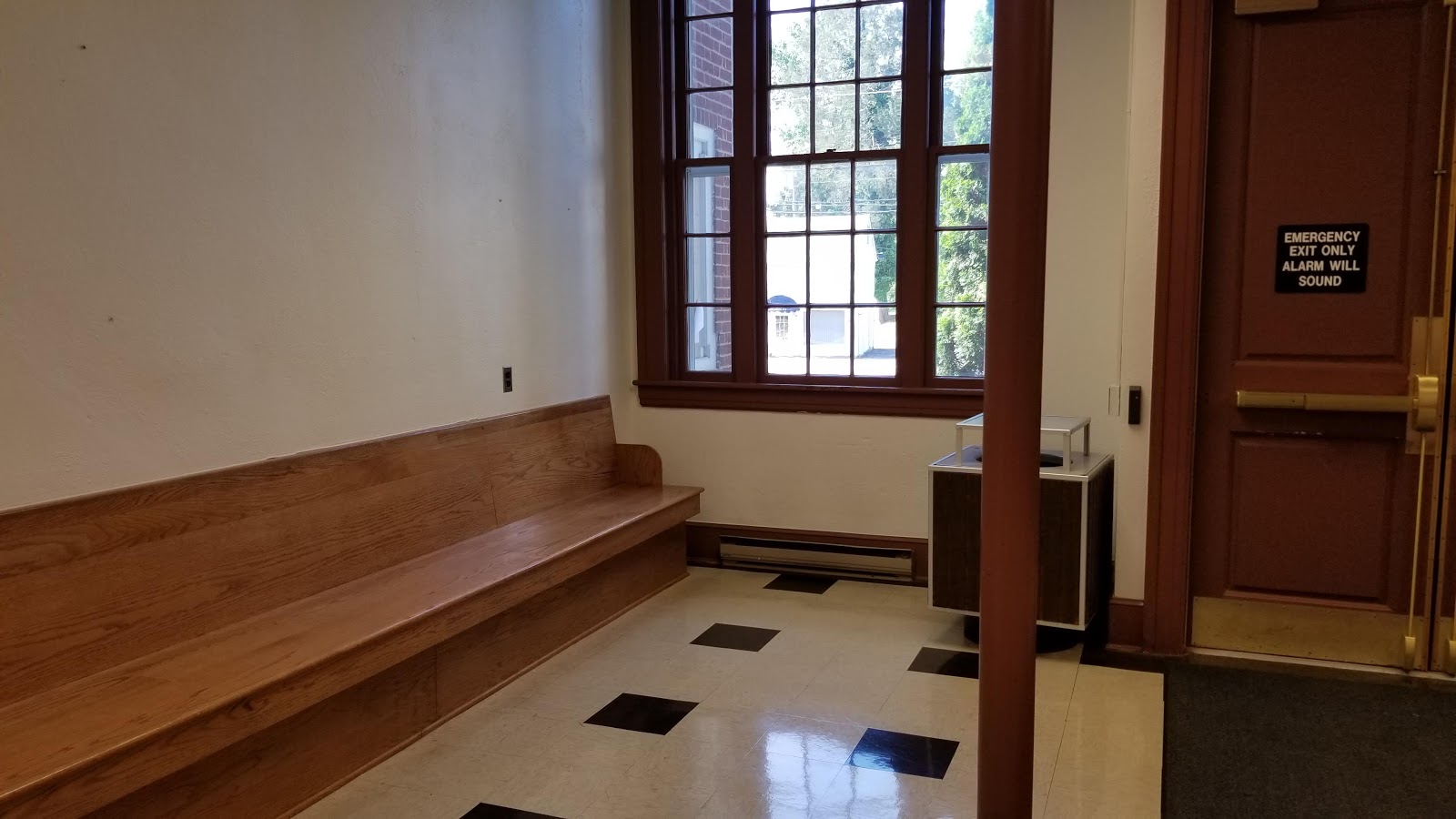
The grand entrance to the Courthouse, as it was built in 1922, is no longer in use and instead serves as an emergency exit. The entryway also serves as a holding pen for those waiting to go into the courtrooms. With defendants, plaintiffs, attorneys, children, and more sharing a small space, it can easily get crowded. Seating is limited and hallways are narrow. My tour was during a "slow" court day and I still had to endure winding my way through the 20 or so people standing in the hallway.

The other side of the entryway was full of people.

We concluded my tour back in Mason's office where I took two final pictures. They show the same corner above two plaques honoring citizens that have served the County. Above both plaques, the signs of mold remediation are apparent. What you don't see is the efflorescence and water stains that were there a few weeks ago.

Efflorescence has been removed but patching and paint are still needed.

Elwood Mason on the left and Joan Owens on the right.

As I said previously, there were certain things I didn't take a picture of so you will need to rely on my descriptions instead. First, the security issues. I won't detail the problems for fear that somebody could exploit them. But I will reiterate some of those already made public in previous Supervisor meetings. Shared hallways. Weak sally port. Narrow hallways. Blocked exits. Shared waiting areas. Cramped holding cells. The list continues beyond this and, in my opinion, is much scarier than it sounds. I firmly believe it's not a matter of "if" something bad will happen but "when" something bad will happen.

The second major issue I didn't take pictures of is the overcrowding. From the heart of the building, the court room, to the outside parking lot, the building is entirely too small to serve the needs of the residents and County employees. Even though it was a slow day in court, we hastily went through a courtroom while the judge was in recess. The front row was empty because only a small child could fit there. The other rows were crowded and looked like they had as much legroom as an airplane or school bus. Outside in the parking lot I saw attorneys talking to their clients because they had no meeting room available to discuss their case in private. I saw a line of people waiting to pay fines stretching out into the hallway. A few days after the tour, Mason sent me images from the security cameras on a much busier day.

Faces redacted for privacy.

Faces redacted for privacy.


Our Courthouse was built in 1922, added onto in 1953 and again in the 1970s, and renovated in 1995. Fire repairs were made in 2006 and security upgrades were made in 2014. But at nearly 100 years old, the building is showing serious signs of age. Moisture is wicking up from the concrete slab, water is draining towards the foundation, and the roof leaks. Augustus Washington, George Washington's father, filed his will in our Courthouse. Housing documents of any importance does not appear safe. Housing the 20 to 30 staff members on a daily basis isn't safe either.

When I asked Mason what he felt the big issues were, he said the security issues and lack of space boiled down to public safety. After taking a tour that gave me access to 90% of the building, I'm inclined to agree. I avoided the political hotbed issue of what the solution should be and instead asked Mason what he would do with the Courthouse if a new one was built. He said the issues outside really needed to be addressed first, namely the drainage. Then inside, it should be gutted and refurbished. After that, he said a number of people could easily occupy the space including the King George County Historical Society, the County Registrar, a welcome center, and more. As a lifetime member of the King George County Historical Society, I admit I'm partial to opening a museum inside.

One final thought in closing. Mason said many people argue against a new Courthouse because they don't want to build a "palace for the judges and the criminals." When you've been working in a Courthouse that's more like an outhouse, anything resembling indoor plumbing would certainly feel like a palace.