Local Leader Interviews

Click here for a list of all the interviews with #localleaders.
Showing posts with label history. Show all posts

Monday, February 24, 2020

OPINION - It's More Than Just A Building

by Neil Richard
Photos by Rebecca Gamble

As a fan of history, I find hearing the stories more compelling than memorizing the dates. As a young child, my father dragged me through countless battlefields and historic towns where I did my best to occupy myself in a time without cell phones. Sometimes this meant taking photos of statues. Or sleeping. Or reading a book. But when I could participate in the Boston Tea Party by throwing a bundle of "tea" overboard in Boston, I found history a little more interesting.

Since then, my love of history has grown. Mrs. Ashton and Mr. Picariello, high school teachers, and my college professor Dr. Joseph Laythe, helped feed that love. But there were stumbling blocks along the way. Mr. Pekarek in high school and Professor Hickey in college gave me a tough time. I didn't know it then but it was for my own good. After all these years, my love of history has become even stronger. But more focused. I don't care that much about the dates. Or the buildings. Or the cities and countries. It's the people. The people that make the history. The people that lived the history. The people that told the stories we know and love today.

Or in the case of the Smoot Library, the stories we didn't know.

The Lewis Egerton Smoot Memorial Library has been a cornerstone of King George County for the past 50 years. But it's more than just a building. It's more than just the books that sit on the shelves inside. This Library has a history that goes beyond the past 50 years. It has connections to Presidents, famous buildings, and, in some cases, it's tied to some not so pleasant points in history.

Monday, June 17, 2019

2019-05-07 - A Tour Of The King George County Courthouse

by Neil Richard

After I concluded my interview with local leader Vic Mason, Clerk of the Circuit Court, I asked if I could take a tour of the building to see if it was really as bad as everyone said. Not that I didn't believe the reports but I had never really seen much first hand. Aside from some peeling paint, it looked just fine at first glance. It turned out I was wrong. Very wrong.

As a casual observer, it is easy to walk past the issues on your way to a trial or to research deeds. But if you slow down, the issues will start to appear. Diving deeper into the labyrinth of offices make things even easier to see, and in some cases, feel.

Starting in Mason's office, we could see where the mold remediation had taken a toll on the cinder block wall itself. In order to remove the mold, large pieces of the block had to be removed. This scene was repeated throughout the building in numerous rooms and offices.

Removing mold required removal of parts of the wall.


While still in his office area, we saw computer equipment sitting directly under geothermal lines in the ceiling. Mason said they had leaked several times, requiring the replacement of a large scanner.

Peeling paint and a dirty air vent were common throughout the building.

The Courthouse stores many historical documents. Some are copies and some are originals. For those documents where we house the copies, the originals are housed in Richmond. Because some of these documents are stored in older formats, older equipment is necessary to access them.

For those under 40, this is a microfilm machine.

I could have spent all day taking photos of peeling paint in the Courthouse. It really is that bad.

The main hallway paint is peeling.

A judge's office has peeling paint.


Before I started the tour, I told Mason that I didn't want to take pictures of people to preserve their privacy. I also didn't want to take pictures of anything related to the security of the building. He offered to tell me when I was getting ready to take a picture of something I shouldn't. While in a judge's office, the judge commented that it wasn't a secure location and that nothing prevented a bad guy from going "kablooie" with a shotgun from outside his office. Even though he might have said "kablammo" the point is still the same. The building has serious security issues that a coat of paint will not fix.

As we walked through her Commonwealth Attorney's office, Keri Gusmann came out to say hello. As I took a picture of a dehumidifier, she said there are five in the office that get emptied three times a day. Gusmann said she'll even try to come in on weekends to empty them.

One of three dehumidifiers I saw running non-stop.


Rosie, one of the building's maintenance staff, was nice enough to open the room that housed some of her cleaning supplies. It was less a room and more cramped closet with numerous geothermal and plumbing pipes running through it. Her cleaning cart barely fit inside. The other room she opened showed more geothermal pipes sharing a room with computer equipment and the buildings telecommunications board. The pipes showed clear signs of leaking.

Rust on metal means something leaks.

The large white pipe showed signs of leaking. In the background is a rack of computer equipment and the entire backbone of the phone system.

Having a degree in Criminal Justice, I'm well versed with the basic tenants of law enforcement. When Mason showed me the holding cells for defendants coming to court, I was shocked at how few there were. Having four cells twenty years ago may have been enough but not for the present case load. Mason said there were 94 felony cases in Circuit Court in 1994. In the first three months of 2019, he said there have been 238 cases. He added that during a recent court day, six people needed to share a cell designed for one person. While I am okay with punishing those that do wrong, I think this opens the County to potential litigation on the grounds of cruel and unusual punishment.

One of four holding cells.

As we continued through the rat's maze of corridors, we came through the hallway shared by defendants, judges, and attorneys. Further proof that the building is not as secure as it could be or should be.


We saw some of the larger rooms in the building that had seating for 30 to 40 people. Mason said that they use it during jury selection but sometimes need to put the other 30 to 40 potential jurors in the Revercomb's Board Room, requiring citizens to walk across the parking lot and subjecting them to the elements and potential security threats. The rooms also showed signs of leaking. Mason said the ceiling tiles had been replaced so many times, they no longer matched.

An alarm located below a leak.

We took a quick look at the two rooms that had been closed off during the mold remediation. While the carpet was new, there were still signs of peeling paint and leaky doors.

New carpet, old paint, and a leaky door.

Once again in the main hallway, we saw a painting by John "Jack" Darling of Washington's Mill hanging on a wall. A wall of peeling paint.

Darling knew the Kennedys and Jimmy Stewart.

Another trip through another office led us to encounter a unique set of offices. A room led to an office through a door. Yet, in the same wall, was another door. There was no evidence of any previous wall or any reason to have two doors in one wall. Adding to this confusion was why one room was much warmer and more humid than the rest. The nice employee that tolerated me poking around said the new HVAC units made things better in some places but worse in others.

More dirty air vents.

One oddly shaped office still showed clear signs of efflorescence. During my last visit to Mason's office, he had much larger signs of efflorescence that had since been removed. For those not familiar with it, efflorescence is a visible indicator that not only is there a leak, but the minerals in the wall are dissolving. I touched it to see if it was a painted crack or imperfection from the original construction. Instead it turned to powder in my fingers and I immediately regretted my decision.

That weird wrinkle is efflorescence.

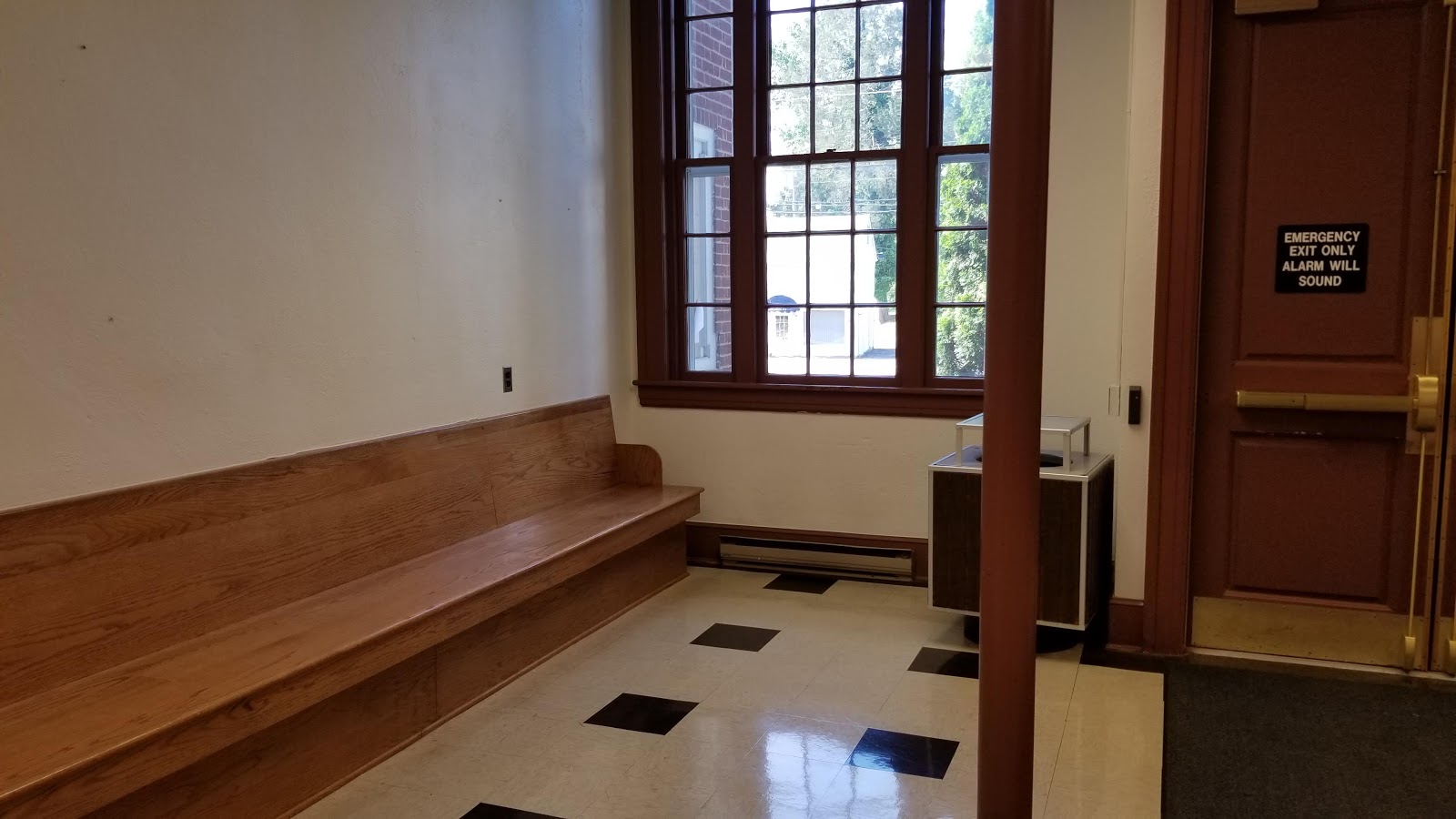
The grand entrance to the Courthouse, as it was built in 1922, is no longer in use and instead serves as an emergency exit. The entryway also serves as a holding pen for those waiting to go into the courtrooms. With defendants, plaintiffs, attorneys, children, and more sharing a small space, it can easily get crowded. Seating is limited and hallways are narrow. My tour was during a "slow" court day and I still had to endure winding my way through the 20 or so people standing in the hallway.

The other side of the entryway was full of people.

We concluded my tour back in Mason's office where I took two final pictures. They show the same corner above two plaques honoring citizens that have served the County. Above both plaques, the signs of mold remediation are apparent. What you don't see is the efflorescence and water stains that were there a few weeks ago.

Efflorescence has been removed but patching and paint are still needed.

Elwood Mason on the left and Joan Owens on the right.

As I said previously, there were certain things I didn't take a picture of so you will need to rely on my descriptions instead. First, the security issues. I won't detail the problems for fear that somebody could exploit them. But I will reiterate some of those already made public in previous Supervisor meetings. Shared hallways. Weak sally port. Narrow hallways. Blocked exits. Shared waiting areas. Cramped holding cells. The list continues beyond this and, in my opinion, is much scarier than it sounds. I firmly believe it's not a matter of "if" something bad will happen but "when" something bad will happen.

The second major issue I didn't take pictures of is the overcrowding. From the heart of the building, the court room, to the outside parking lot, the building is entirely too small to serve the needs of the residents and County employees. Even though it was a slow day in court, we hastily went through a courtroom while the judge was in recess. The front row was empty because only a small child could fit there. The other rows were crowded and looked like they had as much legroom as an airplane or school bus. Outside in the parking lot I saw attorneys talking to their clients because they had no meeting room available to discuss their case in private. I saw a line of people waiting to pay fines stretching out into the hallway. A few days after the tour, Mason sent me images from the security cameras on a much busier day.

Faces redacted for privacy.

Faces redacted for privacy.


Our Courthouse was built in 1922, added onto in 1953 and again in the 1970s, and renovated in 1995. Fire repairs were made in 2006 and security upgrades were made in 2014. But at nearly 100 years old, the building is showing serious signs of age. Moisture is wicking up from the concrete slab, water is draining towards the foundation, and the roof leaks. Augustus Washington, George Washington's father, filed his will in our Courthouse. Housing documents of any importance does not appear safe. Housing the 20 to 30 staff members on a daily basis isn't safe either.

When I asked Mason what he felt the big issues were, he said the security issues and lack of space boiled down to public safety. After taking a tour that gave me access to 90% of the building, I'm inclined to agree. I avoided the political hotbed issue of what the solution should be and instead asked Mason what he would do with the Courthouse if a new one was built. He said the issues outside really needed to be addressed first, namely the drainage. Then inside, it should be gutted and refurbished. After that, he said a number of people could easily occupy the space including the King George County Historical Society, the County Registrar, a welcome center, and more. As a lifetime member of the King George County Historical Society, I admit I'm partial to opening a museum inside.

One final thought in closing. Mason said many people argue against a new Courthouse because they don't want to build a "palace for the judges and the criminals." When you've been working in a Courthouse that's more like an outhouse, anything resembling indoor plumbing would certainly feel like a palace.

Monday, May 6, 2019

An Interview With Vic Mason - Local Leaders #6


by Neil Richard


Introduction


The basic idea behind this interview series is to interview local leaders that live, work, or have an important impact on King George County. We have asked various citizens for recommendations on who they see as a local leader. Additionally, we feel that everyone has a story and it deserves to be told. So we want to know their story. As you can see with the questions below, we want to share their  story with the rest of the citizens in King George County. If you have somebody you would like to nominate for a future interview, please contact us.

Vic Mason sitting in front of a portrait of his late son, SGT Nick Mason.


Editor's Note: 

Mr. Mason was hesitant to be interviewed. I think this was partly because he didn't know me but also because, as he readily admitted, he didn't see himself as someone worthy enough. During the interview, it became apparent why his name was mentioned by Sheriff Dempsey and others. Mason is a leader in the community and gives back not only in his role as Clerk of the Court but in other ways. His interview was by far the most emotional one so far. Listening to him talk about how his son's death impacted his life was moving in the moment and even more so as I began transcribing his answers. [I would encourage you to consider participating in the upcoming Some Gave All Ride event on June 2, 2019.]


Basic Biographical Information


I graduated King George High School in 1973. I took college classes at Rappahannock Community College but I was not necessarily, at that point in time of my life, focused on academics to say the least. But I took some classes. Took some in law enforcement and other things. And not a whole lot of formal schooling or education after that. I've taken and taught classes through the Clerk's Association. But that's about it for the academic side of it.

No, I don't need any special certifications to be Clerk, anybody can run for it. It's not like the Commonwealth's Attorney where you have to be an attorney. But that's the only certification for that job, to have a bar license. Nothing really special to be Clerk. It's a very interesting, challenging job though because there are so many different things. We handle all of the land records, which King George has back to 1720, 1721. A lot of localities don't because during the Civil War the Union troops came through and burned the records. One of the Clerks, his last name was Brown, took all the records and stored them in his attic. That's why they were saved so when the troops came through there wasn't a whole lot to burn.

So we keep records, land records, marriage licenses, we don't have them that far back because Vital Records takes care of that now. We handle criminal and civil cases. All the felonies come through the Circuit Court. Anything over, I want to say $25,000 now, has to be a Circuit Court case. It's the only court in Virginia that has juries. We also take care of, which is probably the most satisfying job and probably the most interesting, is probate where we handle people's estates. You get to help people. You leave the office at the end of the day and you feel like you've helped somebody. That's what makes it all worth it. States like Maryland have three separate offices for what we do here. They have a probate judge that handles nothing but probate. They have a land record office and then a separate courts office. Virginia Circuit Court does all three so you never know what's coming through the door and that's what makes it interesting.

So I do a lot of talking and don't really answer the question you asked me.

No military experience. I was President of the Clerk's Association in 2010. Technology Fund, or TTF, Committee Chair. In the Clerk's Association I've served on a number of different panels and committees. Hunter Education Instructor in the area. Then of course the two foundations, the scholarship foundation. I'm a Director on that. And the Some Gave All Foundation, I'm a Director on that. Both of those are very rewarding. In the end you get to help somebody. You get a good feeling at the end of the day when you get to do that. With the memorial scholarship I think we've given out in excess of $125,000 in scholarships to King George graduates. That is very eye opening because a lot of times what I see through the court system is not the most focused or dedicated of people. But what you get with some of the applications, you wonder how they do what they do in 24 hours. So that's very good. Then of course with the Frazier-Mason Foundation we assist a lot of disabled veterans that have fallen on hard times for whatever reason. A lot of them deal with PTSD making it difficult for them to deal with certain things and to be able to take a little of the pressure off, like if they haven't been able to pay their mortgage or rent or car payment, it has worked out well. I guess the most important part of both of them is they've both become very big community events. We set up the foundation but the community supplies the support, especially financially. That's been a good feeling just to see how caring a lot of the people in King George are.


Personal Questions


What do you remember about your grandparents?
I remember both my grandmothers very well. My mother's father died before I was born and if you look at the picture hanging behind you, he worked for the railroad but he also hunted and trapped on the side for a little extra income. So that's a picture of my mother and him back about 1940. My father's father, he died in 1960 so I was a little bit over five years old so I don't remember but so much about him. But both my grandmothers lived and grew up here in King George. In fact one lived across the road from us and the other was down by Sue Williams' office. King George was really a small community back then. Both of them were very caring and loving. Completely different people but very caring and loving people.

My mom's mom, I remember more than anything she had a little fish pond outside. Used to love to watch the goldfish. And sitting in her kitchen in a little nook drinking coffee and eating toast. Dipping the toast in the coffee when I was five, six, seven years old. And like anything, you see them grow older and start to struggle with memory and not being able to do things themselves. That I guess gives you a different perspective. At that point in time your parents are 30 or 40 years old and you're 10 to 20 or 30 or somewhere in that range. It gives you a different perspective on things in the cycle of life.

My dad's mom, she was a very religious, very caring, very personable woman. I would see her just about on a daily basis. Probably why I remember her a little bit clearer. She lived to be like 97 or so. But she would get out and work on her flower beds, her garden, every day. She could run that grubbing hoe all day long. She was a little teeny woman and it still amazes me how she could do that.

What historical events influenced your life the most?
Probably the one I remember the most was when Kennedy was assassinated. I think he was a very popular and dynamic person and I was probably 8 or 9 years old. And then of course 9/11.

I think the Kennedy assassination just sort of, I guess, burst the bubble where everything was good and kind and people are really nice and then you see that. The planes going into the Twin Towers, you realize everybody is subject to somebody else's' hatred. At any moment in time to take so many lives so needlessly. Shortly after that my son went and enlisted. He was 17 so we had to sign but we knew what he was going to do. It was either sign when he was 17 or wait for him to be 18 and he would sign it by himself. It was something he really wanted to do.

When he was killed, it was probably the biggest impact that anything has ever had on my life. But the wonderful thing was how the community came together. You don't get that in all communities. Probably as communities grow, people know less of their neighbors because there are so many. But it is still small enough now that when something like that happens, everybody comes and lets you know they are there. That of course led to us being able to give back through the two foundations, the scholarship to high school students and the other for disabled veterans. Something good comes from everything. If you want it to.

Outside of work and home, what is your favorite place in King George?
Generally outside. I love to duck hunt. And it doesn't matter, we talked earlier about standing in the rain in the 30s, never had a bad day duck hunting. A lot of days we've gone out and gotten wet or fallen in the water. The boat hadn't started. Forgotten to put the plug in. But it's always been enjoyable. Also, the Some Gave All Ride. Outside doing things. This past weekend I was outside working in the beautiful weather. Even when it was windy and blowing. The outdoors. There's so many things you can enjoy. And King George is still rural enough, I don't know if there's anywhere you can go where you can't hear a car, but there are a lot of places where you can go and it's peaceful. And I love solitude.

What person, place, or thing do you think is the most underappreciated in King George County?
That's going to be tough because you're trying to ask me for a singular answer. I think the fact that we're between two rivers. There's so many places you don't get to see and all the wildlife. The power that Mother Nature can have.

But then there's so many people. And that list could go on for miles. Teachers in the schools. Community leaders who did something almost every day, every week, and never looked anywhere for any recognition. They did it because they wanted to and it was the right thing to do. There's so many people it's hard to bring that into focus into a single answer.

But the warmth of the community. The ruralness of it, even though that's changed a lot, especially since I grew up. We used to sit in my grandmother's porch on Sunday and would count cars that came down Route 3 right here through the middle of town. And sometimes it would be 10 or 15 minutes before we see a car. Now if you can go 10 seconds without seeing one. So that's a change I've been able to see. The good, bad, and ugly.


Professional Questions


Who is your inspiration or mentor?
I guess my father and grandfather. I never truly understood the importance of this job to the community. I didn't know my grandfather that well but he was here for 43 years, from 1917 to 1960. I always hear things from people who knew both of them. I don't hear that much from people who knew my grandfather anymore but 25 years ago when I first came into the office I did. I was a whole lot smarter in my teens and twenties than I am now. Because at that point in time I Was much smarter than my father. I guess maybe I've gotten dumber every year because I realize there's less and less that I actually know. And he did tell me one time that I was the smartest teenager he ever met. And i kinda took that as a compliment when he said it but looking back on it I'm not so sure there wasn't a little bit of sarcasm and cynicism in that.

So I guess understanding the importance of this office to the community and the effect it has on everybody's lives. So I would probably have to go with them.

What is your ideal vision for King George County in the future?
My ideal vision would be to slow the growth but it's hard to draw the line between property rights and the rights of people. If you have a farm with 200 acres and all you're doing is paying taxes on it, it's hard to tell that person no, you can't develop that. Somebody worked hard to get that property in that family and just because I want to see it stay agriculture, doesn't mean that they do. So that's a very difficult balancing act, to slow growth while still allowing people who own the property to do what they can to make it profitable.

So I would like to see King George County slow up as far as the growth but it's not going to happen. It's going to speed up when they bring that other bridge and there's an increase in traffic. Which will bring an increase in good but also the bad. You know, people like to go to Walmart but if you look in the General District Court case loads, it's like they have a sign up in every other aisle in Walmart that says steal me. And it's going to bring more transient traffic. More pressure on the Fire and Rescue. More pressure on the Sheriff's Department. More pressure on the court system.

So, controlling the growth but I don't have the answer on how to do it.

What do you feel are the top 3 issues to address in King George?
The top three issues are infrastructure, like roads and water and sewer, controlling the growth, and for the County to have the best plan they can have in place to accommodate growth. Schools, courts, infrastructure, things like that. And then being able to adjust that plan on an annual or semi-annual basis.

What do you feel are the top 3 successes in King George?
Definitely the community as a whole and its caring. You see so many people do so many things, charities. Considering the rapid growth and the changing dynamic of the County, I think the administration, the Board, overall has done a good job over the past 20 to 25 years in dealing with it. Certainly you can look back and say things that could have been done better but anybody can do that. I think overall they've done a good job. I think the services provided overall, certainly you can improve on anything but that should be the goal no matter how good a job you do. But I think the schools, the courts, Fire and Rescue, Sheriff, those services provided by the County during this big period of change, I think they've done a pretty good job. I've seen in a lot of places where they've done a lot worse.

What person, place, or thing do you think we lack in King George?
Again, this is a me me me answer. I would like to see a good steak house where I can go and get a nice steak dinner. It doesn't have to be a gourmet one but there's so many places you can get subs, pizza, burgers. There's no where you can sit down and get steak. You can sit down and get a nice meal but I'm a beef eater. That's what I would like to see as far as a service coming to King George. For self interest it would be a steak house.

Wednesday, April 10, 2019

2019-03-27 - King George Track Ribbon Cutting

by Neil Richard

The King George High School track has been open for business for a few months already but today was the official ribbon cutting ceremony. With several dignitaries attending, the ceremony was brief and to the point. Athletic Director Alex Fisher hosted the ceremony with everyone gathering at the far end of the track. School Board Chairman T. C. Collins said a few words, mostly thanking everyone involved in making the project happen. The crowd applauded current and former Coaches, Athletic Directors, School Board Members, County Supervisors, track athletes, parents, and community members.

Matt Boyd, former track and cross-country athlete, returns to King George for a lap around the new track.

Jeff Bueche, Chairman of the Board of Supervisors, was also invited to speak a few words. He thanked everyone for attending but said he couldn't take credit for the project and instead thanked Jim Howard, former Supervisor, for being an advocate for the new track surface.

Near the finish, Cathy Binder, Ruby Brabo, and several track athletes give T. C. Collins a challenge.

Fisher then explained that even though there were a lot of competitive people on the track, including those currently on the track team, he wanted to make sure that T. C. Collins, Jeff Bueche, and Jim Howard were at the front of the pack and crossed the finish line first.

Dr. Neiman Young, Matt Boyd, Jim Howard, and Jeff Bueche make it look easy.

As expected, the competitive people took off and Collins barely edged out a win. There were no official results for the non-certified 100 meter race, but based on the photo finish, Ruby Brabo finished second and Cathy Binder tied for fifth. Jim Howard, Jeff Bueche, and Dr. Neiman Young, County Administrator, took a more leisurely jog across the finish line. A few local residents, School Board members, and former parents took their time walking and enjoyed the new rubberized surface.

Photo courtesy of Gary Butler. Used with permission.

The roughly $1 million project was cash-funded by the County as the old surface was in dire need of repair. The old rubberized surface prior to the newly installed surface was in such bad shape that several sections of the track had worn down to bare asphalt. Local track teams would not run on the surface citing safety concerns, forcing King George to travel to all of their meets. Prior to that old rubberized surface, the original track had a dirt and cinder surface. While this made long track spikes legal, it also made falling more painful.

Photo courtesy of Gary Butler. Used with permission.

Photo courtesy of Gary Butler. Used with permission.
1974 Boys Track Team. Photo courtesy of Cathy Binder. Used with permission.

The old cinder track on display. Photo courtesy of Cathy Binder. Used with permission.

As seen in some of the above pictures, the King George High School track has a long tradition of being an important part of the County's history. It not only serves as a place for student athletes to compete, but also a place for parents, students, and coaches to learn about good sportsmanship.

Tuesday, February 19, 2019

History of the Service Authority - Part 3 - 1965 to 1970

by Neil Richard

In previous articles covering the history of the Service Authority, Part 1 covered 1948 to 1959 and Part 2 covered 1960 to 1964.

Beginning in 1965, the State took notice of the pollution in the County. In March, the State Water Control Board condemned Williams Creek and Machodoc Creek to prevent shellfish harvesting. In April, they said it was not due to the most recent residential developments. Despite this claim, in May the State Water Control Board approved 100 homes and the Willow Oaks Apartments to flow their treated waste into Williams Creek. Also in May, the development called Cloverdale changed its name to Bayberry.

June 24, 1965 - Bayberry Estates

An engineering firm, Russell and Axon, presented a study that showed a need for a central water and sewer system. D. M. Martin, an engineer for the firm, presented a petition signed by 75 voters in support of a Dahlgren Sanitary District. The Board of Supervisors passed a resolution asking Circuit Court Judge S. Bernard Coleman for a bond referendum to create the Dahlgren Sanitary District. On April 20, 1965, the Circuit Court finally created the Dahlgren Sanitary District.

July saw sewer problems at King George High School and Lawrence Roller, the school Superintendent, asked for a single lagoon to solve the problem. He requested five acres at Arnold's Corner for the lagoon. That same month, local meetings were held with the Sanitary District Committee, the Dahlgren Civic Association, Sydnor Pump and Well Company, various health officials, consulting engineers, and interested residents. The purpose was to discuss the Dahlgren Sanitary District.

By the end of July 1965, 220 of the 228 qualified voters within the Dahlgren Sanitary District voted to approve a $700,000 bond by a vote of 132 for and 88 against. Along with the voters, Supervisor Woody Saft also approved the measure. It was noted that only those residents living within the Sanitary District would pay the tax.

Moving into to 1966 we begin to see disagreements and issues with how the newly formed Dahlgren Sanitary District operated and what the water and sewer system requirements should be. These disagreements sparked meetings in Richmond with Deward Martin and Jeule Elliot, both consulting engineers, legal advisor Alfred Garnett, Wilma Pounds of the State Water Control Board, Supervisor Woody Saft, and even Senator Paul W. Manns.

In late 1966, the Stafford Well and Pump Company was authorized to operate the water and sewer system in Bayberry Estates. Douglas and Dickinson, Inc. of Warsaw was approved to install a water system in Ninde that couldn't exceed 80 connections.

1967 brought more progress, and strife, to the budding Dahlgren Sanitary District. In March, the Board of Supervisors approved the tentative terms from the Farmers Home Administration (FHA) to clear the way for a a $55,000 bond for the Dahlgren Sanitary District water and sewer system. The bonds sold at 4.5% interest and would be payable in 34 years. This was much less than the $700,000 approved by residents but the consulting engineer, Deward M. Martin, said this was the most that could be obtained from FHA. $84,000 in Federal grants had already been approved. Martin also said that money could be saved by using a two-stage lagoon instead of a treatment plant as well as by using ten inch pipe instead of twelve inch pipe. Martin recommended using the existing wells instead of elevated storage tanks but that the tanks could be added within two years. Martin also said the fire hydrants could be added in the future. Supervisor Woody Saft didn't like Martin's ideas.

In April of 1967, the Board of Supervisors approved the advertisement of bids for the water and sewer system in the Dahlgren Sanitary District. The bids came back in May. Of the eight sealed bids submitted, the lowest was $649,653.43. Once again, reports said that Supervisor Woody Saft was not happy. Later that month, the Supervisors approved the following contracts:

Water systems
  • Section I - G. L. Howard, Inc. - $112,350.90
  • Section II - Elevated water tank - Pittsburgh-Des Moines Steel Company - $38,300
Sewer systems
  • Section I - Gravity systems - T. A. Loving Company - $218,350.90
  • Section II - Sewage Force Mains - Halifax Builders, Inc. - $28,154.88
  • Section III - Sewage lift stations - Halifax Builders, Inc. - $72,900
  • Section IV - Sewage Treatment Lagoons - Moore, Kelly & Reddish - $58,000


The total for all contracts was $527,808.58. The Supervisors also included $113,000 to purchase land, purchase the existing Sydnor well system, pay legal and engineering fees, and highway inspection fees. This brought the total cost of the project to $651,000 with a recommended safety cushion of $20,000.

Deward Martin again contributed his opinion by saying that even though the FHA loan was guaranteed for $550,000, he had been assured by the FHA that it can go up to $600,000. The State Water Control Board, via the Water Pollution Control Administration, also gave a grant for $71,000. It was also noted that there was an attempt to sell the $700,000 bond in 1965 but the National bond market took it's worst drop in twenty years and it never sold. It was also stated that the County applied for funds from Housing and Urban Development (HUD) but was denied.

The State Water Control Board and Donald Zepp, State Game Warden, tested the water in Machodoc Creek in July 1967 and found it to be too salty for large mouth bass eggs, frys, and fingerlings to survive. That same month, Dahlgren resident Howard Yarus, Supervisor Woody Saft, attorney A. W. Garnett, and engineer Deward Martin went to Richmond in an attempt to get the State Water Control Board to approve moving the stabilizing lagoons in Dahlgren.

In August 1967, the Dahlgren Sanitary District installed their first water lines from Ferry Dock Road north along Potomac Drive. They also installed lines on Forest Road, 15th Street, Gordan Drive, 14th Street, and South Williams Creek Drive. The Dahlgren Sanitary District elevated tank had a 75,000 gallon capacity. Mr. and Mrs. Nicholas R. Quesenberry deeded over 6.89 acres to Dahlgren Sanitary District.


By September 1967, the Dahlgren Sanitary District purchased the Sydnor water system and authorized Supervisor Woody Saft to act as agent to make the Dahlgren Sanitary District system operational. A few months later, the Supervisors placed a Want Ad for a full-time agent.


To close out 1967, the Dahlgren Sanitary District acquired land from Mrs. Rose Q. Payne (0.228 acres), Mr. and Mrs. Clifford C. Reed (0.425 acres), and Willow Oaks, Inc. (1 acre). The residents of Bayberry Estates began complaining about cloudy water. The Board of Supervisors approved water systems at Panorama Woods, located between Comorn and Fairview Beach.

In February 1968, Otis L. Zirkle is hired as an agent for the Dahlgren Sanitary District at a pay rate of $5,000 per year. In March, the Board of Supervisors approved renting a building for Zirkle to operate out of for $20 a month. The Supervisors also approved the purchase of office equipment and supplies for Zirkle for $304.50.

The Board of Supervisors instructed the County Clerk, V. Elwood Mason, to write to the owner of the Bayberry Estates development and contractor John T. Ellington. The Supervisors wanted to know what Ellington planned to do to fix the water issues in Bayberry as the state water test results said the water was not drinkable.

Closing out 1969, the Supervisors amended the Dahlgren Sanitary District operating ordinances to allow 45 days, instead of the previous 30 days, before a penalty was imposed for any unpaid bills.

Monday, February 4, 2019

An Interview With Elizabeth Lee - Local Leaders #3

by Neil Richard

Introduction


The basic idea behind this interview series is to interview local leaders that live, work, or have an important impact on King George County. We have asked various citizens for recommendations on who they see as a local leader. Additionally, we feel that everyone has a story and it deserves to be told. So we want to know their story. As you can see with the questions below, we want to share their story with the rest of the citizens in King George County. If you have somebody you would like to nominate for a future interview, please contact us.


Elizabeth Lee, Curator, King George County Historical Society

Basic Biographical Information

I graduated from King George in 1964, what they call the old King George Elementary School. I left high school and went to William and Mary for a year. I always tell people I fell in love. Actually I was leaving King George and I was already in love so I came home and got married. But I still wanted to finish college so I got on the programs that were being offered in Dahlgren. I went back to Mary Washington. They offered all of these math classes. The admissions director looked at me and said "we don't have enough credits here for you to be able to major in math so how about physics." So I graduated with a degree in physics and went back to work in Dahlgren. I retired in 1994.

In the meantime, we had four children. Three boys and a girl. The two oldest boys were in school by the time I went back to school. My oldest told everybody that he was "going to go to school and so was momma."

Special certifications? I don't know. I can't think of any.

So I finished Mary Washington in 1973. I took some graduate classes but like I said, I left Dahlgren in 1994 and I started pursuing my real love, history.

I will add to all of that. The thing that I try to tell the kids and adults that come here to the museum is to look around as you're walking in the footsteps of our founding fathers in King George. You may not hear that very much. We know that James Madison was born here but he really didn't live here. No one realizes that George Washington lived in King George at Ferry Farm. When he was a boy living in Ferry Farm, that part of Stafford was in King George County. And his father's will is in the Courthouse here. He also had family in the Mathias Point area. So I try to emphasize that there is history here. Although at one time, somebody once said that "this County has no history." Of course that blew my mind. But we try to emphasize something. Kids at one point didn't even know that James Madison was born here.

About the time I left work, I became a member of the Virginia Genealogical Society and I was almost immediately put on the Board. I've been on the Advisory Board for the Board of Supervisors for the Ralph Bunche School. Northern Neck of Virginia Historical Society. Friends of the State Archives, which is the archival portion of the state library, I was President of that one. I don't know when I wasn't on a board until recently when I've slowed down a little bit.

I was the immediate past President of the King George County Historical Society. I've actually served as the President twice. I've been what they call the Curator but I'd rather say the Director of the Museum and I have been since Day One. I told the President then, if you want to remove me, because it's an appointed job, if you ever want to remove me, just remember I'll be coming in here every day anyway so you might as well keep me here.

Personal Questions

What do you remember about your grandparents?
I told somebody the other day that my roots are so deep in King George, I'm made up of dirt. My mother's family, I never knew either one of her parents. My grandfather died when she was two years old. He worked for Goldsmith's in Fredericksburg. He actually modeled clothes for them. He was a handsome man. He was tall and slender. He had olive skin. My grandmother died about two years before I was born from cancer. So my mother was left to her own defenses then.

My father's side, he was from Buckingham County. I knew both grandparents, they were both born and raised in Buckingham. So I got to meet a little more of the family, the younger part of the family, that way. I was born in Charlotte, North Carolina. Everybody I say that to, I say it was an accident. My father was a bus driver. When I was nine months old we came back here to Richmond but my maternal grandmother's parents were still living up here across from the Historyland Cemetery. Where those apartments are, our house used to be there. We lived there for awhile.

They would come to Richmond and pick me up and I would come up here and spend some time and either they would take me back or my parents would come up and get me. So I remember a lot more of here than I do Richmond. All kinds of memories. People say how could you because I wasn't even four years old when she died. They were really close to me. She had one sister and two brothers that were all still living so I remember all of them. The sister especially thought that the sun rose and set in my behind. She left me everything she had in her will which turned out to be nothing. She became blind and had to be taken care of by social services so they got everything except her bed. One of my uncles gave his farm to my mother and that was where I was raised until I left home and got married.

My grandfather had three sisters still alive after I was born and I remember one aunt who was one of the oldest. She was always in bed and if my mother left us there with her daughter, we would sit on the side bed and I always remember the clock ticking because it was so quiet. We wouldn't say a word. The two youngest sisters, I used to have fun with them because they were fun.

But that's sort of the reason for my love of history because I knew them. Knowing them, I knew they lived a different life than we did. One of the funny things was that we'd go over to the farm and my aunt and two uncles were living there and there was this pile of corn cobs sitting at the door. And I would sit on the floor and build pig pens with these corn cobs. I had no idea until I was grown and it hit me. I know what those corn cobs are for now!

Aunts, uncles, cousins. When I talk about my cousin, she's probably my third cousin once removed, I was around her all my life. They're closer than first cousins.

How did your grandparents instill that love of history?
I wish I could remember any stories that they told me. If I could go back with an adult mind and remember. I guess it was curiosity and knowing them. I thought I knew them but where were they born. My mother even talked about my great grandfather's parents and I knew they were related and it turned out they were first cousins. Their mothers were sisters. And the name was Fitzhugh. The Fitzhughs were a very early name in Virginia. We think William Fitzhugh came here about 1672 and he had probably been here before. He worked for Lord Fairfax and he ended up with something like 50,000 acres of land, including Alexandria.

So I guess what really got me going was how am I related to that man? My grandmother was Elizabeth Fitzhugh. And I worked that all the way back and finally I know how I am related. I actually got enough proof that I was able to get into the Daughters of the American Revolution (DAR). Which I didn't think I'd do because my fourth great-grandfather never married. But he wrote a will and he named all of his children and he named his housekeeper as their mother. And he gave her a legacy. And the DAR accepted it. I don't do much with the DAR but I'm really thrilled that I was able to make it in.

What historical events influenced your life the most?
9/11 changed the way we interacted with our children more.

I lived in Colonial Beach during Hurricane Hazel and the eye went through the beach. That was 1955 I think. It dumped all the slot machines into the river and by the eye of the storm the divers were out diving for slot machines. We witnessed it because my father put us in the car and took us down during the eye. I know you're not supposed to but he took us down there and we stopped and walked along the crumpled up boardwalk. And there were the divers out there.

You said death in a family. Two and a half years ago we lost our daughter. I had gone to El Salvador to get her, we had adopted her. There was a star or planet that was extra bright and I was down there and saw the same one and thought wow, what a small world we live in. Her death changed our lives completely. We went to get her and our lives had been flipped upside down since she died. She has two grandchildren, they kind of hold us together the two of us, my husband and I. One lives next door and the other one is at Edwards Air Force Base. But this old granny knows how to FaceTime and so does he and he's only eight months old.

She left a legacy. You know, I had often thought about what would happen if we had lost one of our children that I couldn't handle it. Then for it to happen to us, nothing, nothing could compare. No thoughts could compare.

This museum has been great. I've devoted a lot of time to it. Jean Graham and I have written a book. It's about Booth's escape. It's about the 34 hours of his time in King George County and what do we know about it. There was a guy that walked the whole route and took pictures back in 1901. So I compared them with family records and photos and came up with a story. And now the board that's working on the 300th anniversary wants us to write another book like the pictorial history book.

Outside of work and home, what is your favorite place in King George?
I'm the only one of my siblings that's stayed in King George. The three boys, one moved to Virginia Beach, one moved to Florida, and one moved to Texas, then Connecticut, then Fredericksburg but he's deceased now. I'm the only one that stayed here. I keep saying I'm just a country girl at heart. I don't want to live in the city or even the suburbs.

Is there one particular place? We have a lot of woods around us. I used to like to go walking back in the woods. I haven't been able to do that more recently. This summer, because of the heat. But we have a farm next to us and then two houses, two pieces of property there. With the farms, it's all open field. Just walking around there. I love going to the park. I like Barnesfield but there's no particular place. I've done a lot of running around in the County, just looking at old places for my book. Looking for where a certain stream comes out. I know that sounds crazy. But just the County or the country-side. I guess that's why I'm not a big development fan.

I used to like to go down to the farm where I was raised. In 1999 an arsonist burned it to the ground just to have fun. Just this past year, something caught the barn on fire and now it's gone. So there's nothing there. The old house that's up on the hill across Route 301 from it was my Aunt Willie's place. So we visited there quite a lot. But that wasn't one of my favorite places. I can't leave the church out because that's probably the place I go to the most now other than home and the museum.


What person, place, or thing do you think is the most underappreciated in King George County?
I think to most newcomers here, they don't seem to appreciate the old homes and the history behind them. They'd just as soon bulldoze them down and build a new house. An example was Willow Hill. It was the home of the Arnold family. Their cemetery back behind their place in Presidential Lakes. They bulldozed that one down to build Presidential Lakes. The Arnold house was right across from the high school pretty much. At least they didn't tear down the cemetery. The old clubhouse in Presidential Lakes where the pool is now used to be Cleveland. The second Cleveland. The original one burned done.

I can't say any one particular place, but I sure would like to have a picture of the Bedford house. Any place I can find an old building.

Professional Questions

Who is your inspiration or mentor?
I have to say two. Bill Deyo. He's the historian for the Potomac [Patawomeck] Tribe. He could tell you anything you wanted to know about Stafford County people. Even who didn't have the right father or right child, he knew them all. He says his Aunt Polly told him everything. He did a lot of genealogy for Stafford. Of course some of that blew over into King George so he was quite an inspiration.

The other one was our friend Aubrey Jennings. When he retired from Dahlgren, several years before I did, he went to work and most of what is in our file cabinets came from him.

What is your ideal vision for King George County in the future?
Very controlled development. I really wouldn't want to see any more but that's not going to happen. But I would like to see a lot of consideration for our history. A lot of times people will just go bulldozing through something and have no idea about the history. No idea what should and shouldn't be preserved. But I'd like to see that supported by our government. I know they have a lot of other things that have to be done but that shouldn't cost any money, I wouldn't think.

I just have this fear that by the time I get old, I won't recognize the place. I often say that my mother, if she came back today, she would not know where she was.

What do you feel are the top 3 issues to address in King George?
I have to look right here. I try not to get involved with a lot of politics but you can't help it sometimes. The issue here is the County does not really address its history. We have a 300th anniversary coming up and they have formed a committee. Which is a lot better than what happened in 2007 when the whole state of Virginia celebrated the 400th anniversary of Jamestown. We took the lead on that, as in the Historical Society, and we started with the Administrator and it went down to the Assistant and then he sent us to Parks and Rec. So the County never really got into it at all. So that's basically why we wrote the book to that we at least had something to show for it even if the County didn't participate.

Now there's the issue about the Courthouse. I don't want to see anything happen to this building but that may not happen. They, as in our government officials, have convinced me to move our research area into the Virginiana Room in the Smoot Library. I finally agreed after many, many questions. Our books are still our books. Our files are still our files. We'll keep this area, the museum, just for our museum pieces.

The last is we have museum pieces in this County in private homes. We've never been able to show them. They're beautiful pieces. It's lack of space. We found these cases here that go up higher to get more stuff in these than the shorter ones and that's fine for the smaller pieces but it's not good for the bigger stuff. We have a loom. We have a beautiful quilt that was done by slaves in 1835. The family gave it to us because they didn't know what to do with it. It's probably larger than a King Size bed. Some of the spots, some of the areas on it, the material is still bright enough to see the design. You can see the stitching. Very few places where it was torn. But we have to keep it on the shelf in there covered in archival tissue paper. And there it sits. We have the old voting drum. It was a drum about this high that you turn and you'd stick your vote in the slot in the top like a big piggy bank and it rolled and went down. The votes had to be hand counted. We've got a beautiful settee that was sold at auction in 1842 from Spy Hill. What are we going to do with them? I was told we would keep this museum but the other day I was told no, everybody was getting out. We have no prospects. I think the problem is the people that worked on that have no clue what we've got.

What do you feel are the top 3 successes in King George?
I had one earlier and I forgot it.

Our library, I think we've got one of the nicest libraries, at least in the state of Virginia. I think it was the nicest library for any county before they added on. To be able to show that off is great. I had family come in and I said this is our library.

Barnesfield Park is a good one.

Number three. I could always say our Sheriff's Department. It's huge too. I've been on a tour. I think our Deputies are more prepared than they used to be. I remember the good old boy, one or two Deputies. Used to come by the house and "How are you?" and "I'm fine thank you." They seem very professional, much more so than I remember. So that would have to be a success.

What person, place, or thing do you think we lack in King George?
You look down at Dahlgren and they've got McDonald's and Burger King and Arby's. KFC and Taco Bell. Dunkin' Donuts. Starbucks. I love Jersey Mikes. And Five Guys. As much as I don't like the idea of development, I'd like to see one or two things up here near the Courthouse. We've got a Subway. So if we have to tell somebody where's the fast food, that's the only place we have on this side of the County. It's lacking. You've got to want to go to sit down to dinner. Which don't get me wrong, it took me awhile but I finally went into El Charro and they are good. It's really good food in there. Vinny's is not too bad either. But the only place I can run into is Subway.

Jean and I have started ordering pizza and stuff from Pizza Bono. We told them the other day that we're one of their hot spots. They'll bring up here all the time. All I have to say is the museum. Yeah, I would like to see a couple, not a whole lot, just a couple choices up here. I'd go to Dahlgren for Chik-fil-A.

Monday, August 20, 2018

King George Education Foundation Opens FoxSmart Center

by Neil Richard

Thanks to an invitation from the King George Education Foundation (KGEF), I had the chance to learn more about their FoxSmart Center. The KGEF's center is designed to provide students in need primarily with school supplies, although they do offer personal hygiene products and have a small collection of clothing to choose from. School staff can also get supplies that they may need for their classroom. Everything inside is free of charge as their primary "customer" will be somebody without the funding to get the necessary supplies on their own.

The FoxSmart Center opened this month inside of what I affectionately call "the old vo-tech building." Despite my many years as a student of King George County Schools, I have never set foot inside the building that sits between the current King George Middle School and the tennis courts. While the building was still full of stuff left behind after the new high school was built ten years ago, it was in fairly good shape for being built in 1969. The presence of the FoxSmart Center clearly had a beneficial impact on the building.

A Splash of '91 - 1991 King George High School Yearbook, page 131


Despite a heavy wave of nostalgia whenever I go to my old stomping grounds, the current Farmer's Market combined with the Middle School Expansion Project quickly put me on track to focus on my tour. Greeted by Annie Cupka, KGEF President, and Caroline Phelps, KGEF Director of Communication, we first saw the unused portions of the building. The Parks and Recreation Department and the Middle School Wrestling Team use one room on occasion and we weren't sure if the High School's NJROTC cadets used another but their wall mural was still there. The back room was used primarily for storage for the Tennis Team, Middle School Athletic Director, and whoever forgot their gym shorts on the bench.

The NJROTC mural still stands.

Continuing down the hall, we got a tour of the bathroom. Unlike my previous bathroom tour at the Citizen's Center, my photographer felt it necessary to take pictures. Although I felt uncomfortable being in the Ladies Room, absent of anyone using it of course, I quickly learned how important a toilet could be. When the Foundation moved into the building, there was nothing but a hole in the ground. While some may dwell on how bad things were in the vo-tech building, it was clear during the tour that the Foundation's message was much more positive. And their hard work in getting a toilet installed was rewarded by numerous compliments from the mothers and athletes that used the building in the past, but without the toilet.

Many people expressed their joy over the new toilets.

One final note about the tour was the old metal shop portion of the building. Even though it was cluttered and full of everything conceivable, it had great potential on many levels. Some of the items stored there should be put into a museum. Some items can be re-used by the schools for education or athletic needs. Some items could even be sold for a major profit. But the room itself had potential to be used by future students in vo-tech, or CTE if you prefer. Other non-profits could also benefit from such a large space, or even any of the other vacant rooms in the building.

There were countless artifacts like this left in the metal shop.

The same cabinet as seen in the 1991 photo above.
While not all of the graffiti was appropriate, we found the tribute to Sgt. Nick Mason touching.


The Foundation's mission to "unite the community to enhance public education" was clear from the hard work they put into making the building usable again. Aside from getting a new toilet, they also worked on lobbying to get new LED light fixtures installed as well as refurbishing the room they occupy for their FoxSmart Center. And the Foundation's efforts were clear elsewhere as well. Being the first group to use the building on a regular basis in a decade, they've spent long hours working to make improvements. By the end of the tour, it was clear that having the building occupied again was a benefit. A benefit that was more subtle than the school supplies they give to students and teachers in need.

The Foundation's FoxSmart Center has an office.

In talking about the goals of the center itself, Cupka said she felt the Foundation had exceeded their goal of uniting the community to help the schools. Despite exceeding that goal, nobody there looked like they were resting on their laurels. While we toured the room, the Foundation's Treasurer, Christina Arledge-Buck, welcomed a student that was referred by a Guidance Counselor. The student was able to get the supplies they needed for school. There were also stories of students getting everything on their school supply list in one visit, or a student getting supplies sent to their school, or a teacher getting something that they ran out of.

Annie Cupka, KGEF President, beams with pride.

The FoxSmart Center is primarily open Mondays from 2pm to 5pm as well as Thursdays and Saturdays from 9am to 12pm. On Fridays, when school is in session for only a half day, the center is open from 1pm to 4pm (unless it's a holiday weekend). The center is open to any student that's referred by a school Guidance Counselor. If the student or their family is unable to travel to the FoxSmart Center, arrangements can be made to deliver the supplies to the student at school. The center is also open to any member of the King George County School staff without a referral, including nurses.

School supplies for students and teachers.

The FoxSmart Center also has personal hygiene supplies.

The Foundation has had numerous donations from private citizens as well as local businesses. Even as we toured the room, Amanda Zuker and her daughter Paige arrived with a donation of supplies. Companies like Access Eye, BB&T, and the United Way have also made donations, earning the honor of being a Partner In Education.

(l to r) Christina Arledge-Buck, Amanda Zuker, and Paige Zuker.

Cupka and Phelps said they wanted to "get the word out" about the FoxSmart Center and the supplies they offer. They also wanted to shine a light on the Foundation's other work, including their grant offerings and their Evening of Excellence. They also said they need volunteers to work in the FoxSmart Center and that it was a great opportunity for students that needed community service hours.

The King George Education Foundation is a 501(c)(3) non-profit that earns less than $50,000 annually in income. Their brochure and donation needs are below.


[All photos, except the yearbook photo, (c) 2018 by Yvonne Richard. Used with permission.]